Tuesday, September 24, 2013

Planes

Plane flirts with both line and mass. Planes often reveal geometries, logic(s), rules, interests.

 Planes can slide
 Planes can be scored, cut and folded
 Planes can thicken
 Planes can aggregate
 Planes can carve
 Planes can peel back and bend
 Planes can float
 Planes can twist
 Planes can play mass


 Planes can fold
 Planes can be continuous
 Planes can change identities, seem solid at once and then thin as a line
 Planes can replicate


Planes can form a surface
 Planes can be molded


 Planes must be constructed
 The details of how planes meet is important
 The degree to which a plane communicates mass, plane and line should range and be clear
When designing, it helps to envision planes in relationship to regulating lines, coordinates, alignments, constructive processes--some constant that helps guide how your planes move and create space.


Read:  What are possible ideas embedded in these projects?


Utimately, we are asking:  How can the spirit of the planar element express an idea and at the same time engage in the dialogue with the existing site, the original basswood frame, as a way of making dynamic space(s).


Photo notes: If a photograph shown here belongs to you, please email me and I am happy to either credit you or remove the photo from this post.  Thank you!

Thursday, May 9, 2013

Mindfulness + Design


Hi, thank you for having me here today. My name is Liz Swanson and I’m an Associate Professor at the University of Kentucky’s School of Architecture.  For today’s presentation I’d like to share the story of a studio course I recently completed that centered on an exploration of mindfulness and its relationship to design. 

Traditionally, the goal of the course is to introduce the basic elements of architecture and design as a process, with various conceptual themes that guide the assignments.

For this Spring semester, our theme of mindfulness was initiated by my sense —and even shock—at the increasingly dominant presence of smartphones and mobile devices in the classroom.

Deep consciousness of the physical environment and its effects on human experience is essential to the practice of architecture, as is the ability to concentrate for extended periods of time.  The architecture studio has always been a contemplative space that I’ve referred to as a “temple of creativity”:  a zone where students immerse themselves in both the study of existing environments and the  imagination to draw forth architectural works.  Students meet with their instructor for 12 hours a week to develop their ability to break down and synthesize multiple, competing constraints.  Learning to design and build is juggling act that requires one’s undivided attention, as problems increase in complexity over time.

But upon my return of a year’s sabbatical, I was confronted with the ubiquity of cell phones and students’ alarming preoccupation with what I call the ‘virtual elsewhere’: distant, external stimuli accessed only through that little blue screen I found students staring at on campus, during class and always within arms reach.  What struck me most was how public and at times brazen it was:  students focused downward, looking at the phone in their laps, texting during discussions and posting tweets that anyone could read—including their professors. There seemed to me a lack of consciousness on the part of many that ‘classtime’ was not time to text, browse or tweet. 

This sense was corroborated by numerous studies that document the exponential increase of ‘mobile penetration’ with the advent of Twitter, Instagram and thousands of other Apps predicated on entertainment and extroversion. 

Colleagues who felt the same simply said, “take the phones away,’ though this never struck me as progressive or particularly sustainable solution, as putting cellphones in a basket doesn’t necessarily alleviate the need students feel for checking in. In fact, many expressed just the opposite:  they told me that being separated from their devices created anxiety and a sense of lost control:  what if someone needs me and they can’t get through? I realized through our discussions that cellphones are quickly changing the expectations of our relationships, and because so many condense a multitude of utilities onto their phones, their presence makes them seem ever-more essential.

While I have never formally called what I do in my classroom ‘mindfulness,’ I had recently been introduced to the concept and the more I learned, the more I realized its natural overlap with my approach to design:  “Good design requires acting with awareness” and understanding architectural process in relationship to consciousness” have always been emphasized on my syllabi.  But that Fall, I began to question if the exponential uptick of mobile technology in students’ lives might require a more direct dialogue about tuning in by tuning out—because while ‘virtual elsewhere’ may call on increasingly often, it’s possible we answer at the expense of the here and now which in studio’s case, includes that interior realm of the imagination that we *must* connect with in order to design things deeply.  Mindfulness after all, with its emphasis ‘on purpose,’ poses this issue of choice:  that the ways we connect have meaning and impact.  In mindfulness, I found a new way to explore concepts that I hoped could motivate this consciousness, as well as techniques that I hypothesized could increase my students’ ability to concentrate and engage more fully.

In addition to the usual curriculum I’m required to address, my strategy was to incorporate “Movement and Mindfulness” as a studio theme with three goals in mind:  to explore architectural connections between the body, experience and place; to inspire creative thinking about the design process, and to foster empathy, a critical aspect of architectural practice that calls on the designer visualize space for others.

My other motive, which I made very clear to students, was to discuss mindfulness in order to increase their ability to focus for greater lengths of time. We began the semester by discussing the New York Times’ “Why You Probably Won’t Finish Article” and defining mindfulness as means to achieve intense, sustained concentration.  It was explicit that the practice of yoga and meditation were in service of developing a deep and healthy design process.

Programmatically, the semester was organized around the practice of yoga, meditation, and various exercises designed to increase students’ consciousness of their own process and the world around them.  These activities cycled throughout the week, while projects over the course of the semester also shifted in emphasis: from the analysis of the physical body to an exploration of the non-physical mind.

The first project involved the analysis and interpretation of the body in specific yoga poses. Students were encouraged to choose poses that they themselves could do and develop a sense of the internal forces and full considerations at play. 

Structure, Form, Tension, Compression, Axes of Movement—so many fundamental aspects of building can be found in language of yoga that the practice facilitated a very direct route for talking about architectural elements and material connections.

Many students noted that by feeling the subtlety of interior forces and the shifting of energy in their own body, they were better able to understand architecture as a living system of complex forces in balance.  This is particularly important in contemporary dialogue as the practical and theoretical emphasis of architecture has shifted from a concern for stylistic or visual monumentality to one of sustainability and performance.      

For example, poses that appear symmetrical and static, such a Locust pose, were translated into dynamic, assymetrical objects to express the struggle and difficulty in achieving the stance.  Other projects, such as this interpretation of King Pigeon, sought to express internal tension and stretch felt by the participant.

Additionally, in speaking about yoga, the studio emphasized the relationship between body and mind as an analogy for the design process itself.  When holding a pose with focus, for instance, students experienced that body became more stable; but when distracted, the form more difficult to attain.   Early on, this emerged as a simple, but powerful metaphor: work is easier to achieve when focused.
At the same time I began to introduce a series of exercises that challenged students to pay attention in specific ways.  The first was a game that takes its cues from the language of meditation.  Each student was given a length of string scaled to the number of minutes in class, which was placed on their desk as they drew.  Just as meditation calls on one to pull wandering thoughts back to the breath, the string challenged students to remain aware of their thoughts: each time their attention wandered from their work, they were asked to snip the string proportionately and move back into their drawing.

The exercise introduced the element of time, which corresponded to the second project that asked students to situate their designed object into an earthen site and envision them as habitable space.  The assignment was to create a poetic procession that transitioned the inhabitant from outside to inside space and celebrated the ritual of entry.  The assignment explored the cinematic quality of architecture as a series of spatial moments that frame human experience and unfold over time.  Our discussion of mindfulness then broadened to include aspects of relational connections—that being aware of our design decisions requires an understanding of contexts, which by nature are always in flux.

To support this, a second exercise was introduced.  At the beginning of each class, students were asked to close their eyes in guided visualizations, to envision their space as vividly as possible.  At times, I would ask them to focus on seeing specific elements, while at others I asked them to imagine walking the path in someone else’s shoes: for instance, a mother pushing a stroller or an older man with hearing loss. How could the needs of others inform their design? Were there any aspects of the work that stemmed solely from assumptions based their own frame of reference?

These considerations go well beyond ‘accessibility’ or whether a building meets code, as what I’m asking students to do is visualize the atmosphere and impact of their vision of place—socially, culturally, spiritually, and otherwise.  Through guided visualizations, I encourage students to engage architecture as a series of relationships that create site-specific connections that influence our sense of identity.

The third exercise I incorporated into our semester was called “Ideal Conditions,” a practice of noticing the ordinary.  Whenever the climate or light of the season inspired, students were invited to call “Ideal Conditions” at which point the entire class would move outside to simply observe the conditions of the day.  Both as a group and individually, we would walk the pathways of campus, sometimes to draw or simply notice the color of a winter sky, or how branches droop when heavy with ice to form rooms near the base of a tree.   

By becoming more conscious of the subtlety and rhythms in their surroundings, students began to examine how their work could affect the same kind of liveliness and detail.  I’ll never forget when I asked my students to simply lie down and quietly gaze at the passing clouds—something many of us can remember doing as children—and one’s reaction:  “Wow, I really haven’t taken the time to look at things this way,” as stillness of any kind is rare for most.

Architecturally, I think these activities impacted their work in specific ways. For one, sensations such sound, light, texture and physical touch arose as primary aspects for many of their proposals as ways to express conceptual or poetic ideas.  As one visiting critic observed the “students began to conceive of their architectural work as multisensory experiences rather than static, formal objects.”

And second, it allowed an easy way to discuss issues of scale.  As students took time to slow down and notice the smallest scales of design and construction, their awareness of details and material connections increased.  Whereas most First Year students tend to worry about what something looks like, it became easier after the sessions to discuss how things are made.

For the third and final project, our focus continued to shift toward meditation with the design of a Mindfulness Retreat.  For two class periods, students were led by practitioners at Furnace Mountain Zen Buddhist Retreat where they practiced sitting in silent meditation for 2, then, 3, and eventually 8 minutes at a time, an activity that students described as both difficult and invigorating— for many of the same reasons our cloud-watching had made an impact: the silence allowed a kind of reversal, with background sensations coming to the forefront while thoughts fell away—at least momentarily. 

These sessions also forced an interesting conversation about the relevance and meaning of architecture, as meditation (compared to many activities), doesn’t need a building or any enclosure at all; meditation’s boundaries of interior and exterior space primarily occur at the scale of the body.  So do we need a building at all?  Obviously, within the context of my class, the answer is yes—though meditation emphasized the importance of architecture as act that facilitates human relationships and something, that when done well, recedes in favor of the sensations it amplifies.

Having participated in the practice—and the struggle it presented—many students sought to embody their experience by finding forms that could communicate a personal definition.  For example, as one student wrote, “Meditation is the conscious attempt to reveal and embrace the subtle and evasive capacities of the mind,” which in turn generated an onion-like form of multiple shifting planes; while another student explored the perception of spatial depth through layers of spatial frames.   

And while it’s difficult to quantify the success of architectural projects objectively, the feedback I received from students throughout the semester suggests that the exercises we explored did to a more nuanced understanding of the body, the built environment and the creative process.  Over the course of the semester, almost all shared with me some positive affect that they linked specifically to our mindfulness practice, such as thinking more broadly about the experience of others, more deeply about architectural phenomenon and more consciously about their design process.  Of 14 students I surveyed, more than half felt an increased ability to concentrate for longer periods of time, while several expressed a desire to mitigate relationship with mobile technology.

But perhaps most importantly, mindfulness allowed my students and I to engage in a conversation about the value of being present in our lives as designers—because we live a time where the physical and virtual worlds are evermore linked. The pressure to put everything out there right now, along with the sheer temptation that all that information presents, has unprecedented potential to diminish the value of slow, quiet, personal contemplation.   And yet this is exactly what architects need--for however much we may inhabit the world of our smartphones, at some point, we log off, and look up.   

Thursday, December 16, 2010

Laudromats

In 1999, Professor Rene Davids seemed somewhat aghast that I would propose taking seriously my fascination with laundromats. Doing so, he stated, was akin to studying payphones or parking meters: things of the past, technologies (and moreso inconveniences) doomed to obsolescence.  It was understood: 'progress is progress' and in an age with (for it was still 'with' then, not 'of') the Internet, who would argue the idea of coin-operated machines in a communal public setting as anything but, well, just old-fashioned?
Still, today, I find myself once again drawn to the topic as part of a growing interest in personal infrastructure.  From the Coin Laundry Associate's Industry Overview:

National and regional demographics indicate renters, the primary users of coin laundries, are the fastest-growing segment in the nation.

Today’s coin laundry industry is a strong and vibrant one. Even more appealing is the fact that this dependable public service industry continues to grow and thrive. The demographic trends toward an even greater apartment dwelling segment of the population predict continued prosperity.

Saturday, August 14, 2010

Hanging paper stars.

Daughter held the button down on camera today and snapped 15 of these; paper stars that hang from the dining room light.

Thursday, July 22, 2010

Tiny Houses


I'm so excited to have been asked to complete a work for the Tuska Center of Contemporary Art.  The exhibit, a group show titled Aftermath, examines New Orleans in the wake of Hurricane Katrina. As a starting point, I made my way to the wood shop (if only because working with my hands is the surest way to feel like progress is being made).  These little guys are what came out, and the harbinger of what I think might be a fabulous idea.

StreetBond

Friday, July 9, 2010

If You Knew Suzy

This Spring I was the lucky recipient of one advanced copy of Katie Rosman's moving memoir, If You Knew Suzy.  As has been written about extensively here and here and here, the book centers on two tales: of the time Katie and her sister spent helping their Mom fight cancer, and of the year she spent after Suzy’s death researching her late mother's life. Funny and heartbreaking at once, If You Knew Suzy is many stories (like this one and this one) woven into one, the essence and detail of which continues to resonate with me even months after putting it down.  In fact, there’ve been more than a few times Suzy and Katie have popped into my mind, causing me to consider anew many of the themes addressed in the book.

You see in college, as those who have read the book will understand, Katie was for me much like Karen had been for her: a girl I purposely chose as my friend for her fun-loving nature and overall charismatic fire. I admired the way she could seamlessly merge seemingly disperate desires; she was the girl who could get people to rally to the bar on Sunday afternoon for cocktails, yet once there, crank out the New York Times crossword puzzle (easy for her even back then) or lose herself in the newest book she was devouring. And I still laugh every time I recall the day Katie burst through the door announcing she'd just been elected president of the University of Michigan's Golden Key Honor Society, saying, "It's so funny how people will vote for you if you're pretty, even if they don't know shit about who you are."  She could say this, of course, because we all knew her credentials were impeccable: she was intelligent, quick-witted, and at the top of her class (which made the "dumb blonde" joke all the more hilarious).  But mostly, I loved the irreverence and confidence of her observation that was, like it or not, very true.  Perhaps this is why she now reports on pop culture for the Wall Street Journal, a job that allows her to state the facts and draw connections between the various worlds she inhabits.


So, it came as no surprise to learn more about her background growing up--that it was full of such dualities.  She was the daughter of a woman who was simulteneiously hot and cool, a consumer and extremely spiritual, or, as Katie says in her book trailer, "a feisty and loving and crazy woman who happens to be my Mother."  Reading the book, I was reminded of Katie's willingness to say what other's might be too polite or afraid to say, for fear of ruffling feathers.  


But I was also reminded of something else:  that mothers are more than "just Moms:" they are women with lives that were lived long before we arrived on the scene--a truth that many of us who are just now entering that roll finally realize so intimately.  This is, for me, is the beauty of If You Knew Suzy.


Having been gifted the book early on, it was my plan to post a review of book soon after it’s debut.  But alas, like Katie, I have small children which means sometimes good things must sometime wait.  But now it seems the time is right, for after reading today's callous review in the New York Times, I can't help but feel that Suzy, Katie, and in many ways all women, have been misrepresented.  Please find below the complete text of my letter to Thomas Feyer, the editor of the New York Times, an excerpt of which I shot off this morning to letters@nytimes.com.  May they live to be a thousand!


Dear Editor,

To the point: In his recent review of If You Knew Suzy, Katie Rosman’s celebrated debut memoir, Dana Jennings gets it all wrong.  In fact it’s hard to imagine an interpretation of the book that could be more wrong on so many levels.  

Let’s start with what Mr. Jenning’s states as the problem: that Suzy comes across as “vain, materialistic, and manipulative.”  In the book trailer for If You Knew Suzy, Ms. Rosman openly states vanity and materialism are two of the book’s many themes, so calling these out as some kind of journalistic misfire is ludicrous.  What Mr. Jenning’s doesn’t pick up on is that Ms. Rosman places these firmly in the context of dualities:  Suzy IS materialistic, but how?  In the fact that she enjoys fashion, or that she collects expensive objects?  

Saying a love for fashion is materialistic is like saying a kid shouldn’t dress up like a dinosaur or have an imagination.  All creative people know that clothing is yet another extension of one’s expression. Why else do teenagers dress Goth or for that matter, executives in suits?  For the individual and the community one chooses to be a part of, clothing serves as a mode of communication. As the great Coco Chanel once said, “Adornment is never anything except a reflection of the heart. ” Why else do mourning widows and mothers of slain children wear black for a year, but as a way of honoring their loss and love?

As for Suzy’s affinity for beautiful things, entire professions (industries!) revolve around the very human desire to see ourselves in the world around us. As an architect, I was struck by Suzy’s fascination with art glass, a material formed by fire, yet so fragile; her attachment to fine things just as her body began to break down.  As Ms. Rosman wrote in the 2007 Wall Street Journal article that preceded her book, perhaps Suzy’s motivation in assembling sets of such frivolous pieces like antique sorbet dishes was in fact because it comforted her to think of her daughters one day—after her death—hosting ice cream parties for 12 of their best friends.  Surely the NYTimes, a paper that covers fashion and design so expertly, understands significance of clothing and objects of art?

Next, that Suzy is vain.  First of all, so what if she is?  I don’t know a woman alive who doesn’t rue the varicose veins that appeared on her legs after childbirth or the inevitable cringe during bathing suit season as one tries to suck in the tummy.  Could it be instead that Mr. Jenning’s simply feels some hostility toward this kind of woman?  I can’t help but feel the sense that he is annoyed, as if he prefers his ‘cancer books’ have heroines who act a different way.  To ensure it, he advises every author who approaches the topic to focus solely on the painful parts of the disease, to “look hard at cancer, to its treatment and after­effects, to share with the reader the “hard sweet wisdom” that Didion writes of,” (a particularly strange bit advice for Ms. Rosman, who spends a vast portion of her book describing her mother’s experience with doctors and hospitals.)

I suppose he wants more blood-and-guts as he implies their absence reveals Katie’s denial of what cancer is.  But sometimes the most heart-wrenching realizations can be found in seemingly insignificant things:  the smell of a perfume, the softness of sheets, and the pattern of a dress.  In her famous poem “Tulips,” Sylvia Plath fixates on the bob of that cheery flower’s head not because she’s superficial but precisely because in moments of intense pain ordinary things come into very tight focus.  Who cares that she wore Missoni to her biopsy?  Suzy did, because sometimes taking note of little familiar things can reinforce a sense of normalcy and make an overwhelming circumstance feel bearable.  Sometimes, taking part in obviously playful activities in the midst of tragedy (like Katie and Lizzie’s shopping spree) can offer a necessary reprieve during an otherwise unbearable event.  Just ask the residents of New Orleans who insisted on dressing up for Mardi Gras, floats and all, as their city drowned in the devastation of Katrina’s wake.  Such things do more than lighten the mood—they remind us that life goes on, that everywhere people are living, in spite of our grief and disbelief that anything will ever be the same.  Wasn’t this what Ms. Rosman meant when she wrote of her exchange with the nail technician?  That Mr. Jenning’s misses the irony and revelation of that situation is more than a bit obtuse; that he implies true understanding (and dealing with loss) can come in only one form is absurd.

Third, that Suzy is manipulative.  Again, perhaps she was in ways.  As Katie states early on, her mother didn’t always play fair and growing up, her house “was often a dark place.” Later, she even goes on to write a passage about her own life that shows how all that time with Mom may have actually come in handy: in describing her arrival to New York, Rosman recalls how she “cajoled, maneuvered, charmed, manipulated and begged” her way into the media milieu.  Yet I wonder: would Mr. Jennings have the same criticism of a man who used his powers to get what he wanted?  Or would it then be deemed “ambition?” After all, one can frame ‘manipulative’ in any number of ways: as calculated, conniving, or hilariously brilliant strategy, as was the case of Suzy’s yoga-advice for a young woman trying to live with a grumpy husband.  Whatever the case, such a trait—in Suzy, Katie, or anyone—doesn’t prohibit the experience of pain, of suffering loss, and the right to grieve in one’s own way.

But it’s the example that Mr. Jenning’s uses to make his argument that I take issue with, as it reveals just how much he’s missing the point with regard to Suzy's motivation.  “It’d be very healing for me if you had a baby,’ my dying mother said not once but several times (Can you believe she went there? Nor could I),” wrote Katie, in essence admitting just how far her mother could go.  But in my mind, it’s in these moments that we also see just how panicked Suzy must have felt—whether she was able to articulate it clearly or not.  Because Suzy, at that point, was doing exactly as Mr. Jenning’s instructs in his review:  she was tapping into even the most irrational hope that somehow, if she could just see the birth of a grandchild, she would somehow continue to live; in sheer desperation, she was telling the ‘white-boned truth'and trying to stay alive. 
 

But apparently Mr. Jenning’s is only concerned with what HE needs.  “When it comes to cancer books (a label, but the way, that I find insultingly simplistic), we need the thing itself, not the window dressing.” What he doesn’t seem to realize that while it is about cancer, If You Knew Suzy is also a book about mothers and daughters, the loyalty of sisters, the struggle of being a woman and a child, a woman with a child, or a child who realizes your Mother is just a woman, like you.  It is the story of becoming Motherless, recounting the story of watching a loved one die, and coming to grips with the life that the two of you shared—without sugarcoating the flaws.

That Mr. Jenning’s “craves” to “peer into” a certain kind of narrative that “brings back rumors” from the other side says more about him than it does about Suzy, Katie, or any of the readers who so strongly identify with the intricacies of the many stories within Ms. Rosman’s book.  One needn’t have such voyeuristic tendencies to relate to If You Knew Suzy, which for me read like the kind of story you might hear while on a long roadtrip with an old friend.  Ms. Rosman’s plain language and parenthetical asides create a kind of conversation with the reader, while her wry sense of humor (what Mr. Jenning’s characterizes as ‘chirpiness’) cuts an obvious undercurrent of anguish.   As a narrative, Rosman is able to layer decades of time and space into a rounded picture of the lives of three women, that yes, (as memoirs tend to do), center on the experience of the author.
Yet it is precisely Ms. Rosman’s expert ability as a journalist that gives her book an added twist, for how else would she have the know-how to ignite such a journey, a road many of us wish we could take in order to get to know our own parents better.  For while we all might be a little bit Suzy, I think we all wish we could be a little more Katie:  willing to find the time to address our pain directly; able to find the value in the ordinary trace of what’s left-behind; and fearless enough to share it with the world.

For many of us (not characters in books), the “potentially important stories” are those that shed light on the complexity within our lives, and ourselves.  This is the core of If You Knew Suzy, and the reason why so many people have already lauded its achievement.  That the New York Times has missed the mark on this one so fully will no doubt be read as sexist to some; but for me, I think Mr. Jenning’s review is more aptly described as sex-less.  For how can one not respond to the desire to ritualize one’s relationship with their mother by having their hands carressed; to clothe oneself in all the things she would send to make us feel pretty (like dresses in boxes) or cozy or hugged, like plea: if only we were in the same place!  What Mr. Jenning’s misses are that these things are not about spending money.  They are about the body: the ritual of feeling it, fighting for it, dressing and wrapping it, controlling and ultimately surrendering to it. 

Thursday, July 8, 2010

Performa @ FAV

Last month Mike McKay and I were invited to Montpellier, France to participate in the Festival of Architectures Vives, an international design competition founded by (the very adorable) Elodie Nourrigat and Jacques Brion of N+B Architects.  For four days, the following project animated this beautiful courtyard--until it was finally shipped off (did I mention the entire piece packs into 4 small boxes?) to the Nous Gallery in London where it currently resides.
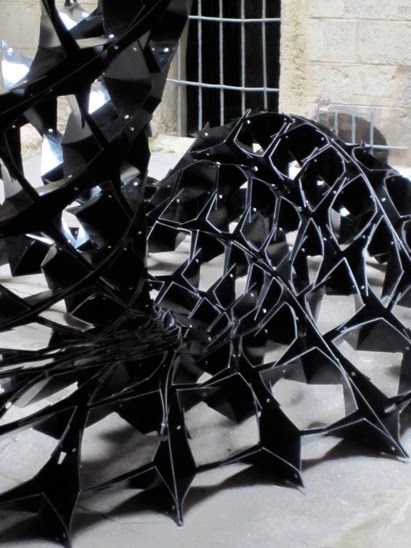
The installation was designed as part of Performa, a seminar Mike teaches at the University of Kentucky College of Design.  Referred to by visitors as "the American dragon," the smoke monster from Lost, and my personal favorite, a flock of bats, Performa is a more than anything a system:  simple units that aggregate to allow for flexibility and variation.  For more information on other projects completed by Performa, check out Mike McKay's amazing website:  www.mikemckay.org.
The Festival of Lively Architecture invites ten young designers to create work within the courtyards of Montpellier's many mansions. The festival aims to combine the work of this new generation with the forgotten eras and places of Montpellier, to create unexpected urban territories.

Performa is multi-performative material system utilizing optimization, aggregation and efficiency.  The system is comprised of identical foldable units that create a high degree of unit and system pliability which allows for adaptation to changing conditions.  These conditions range from highly spatial once deployed to laying completely flat for easy transport.

Additionally, the work explores the sensory affect of its field condition:  variable aperatures of opacity and openness, light and shadow, and their impact on adjacent surfaces.  The work is the result of rigorous digital and physical techniques that tested potential performative characteristics, limits, and strategies of fabrication.